
When Republicans Trusted Science: D-Day and The Film, Pressure, Tell The Story
When and why did it all change?

Quick program note: I will be on vacation from 6/12-6/22 and will not be publishing my column. I may rerun some older columns, but will be taking it easy and goofing off.
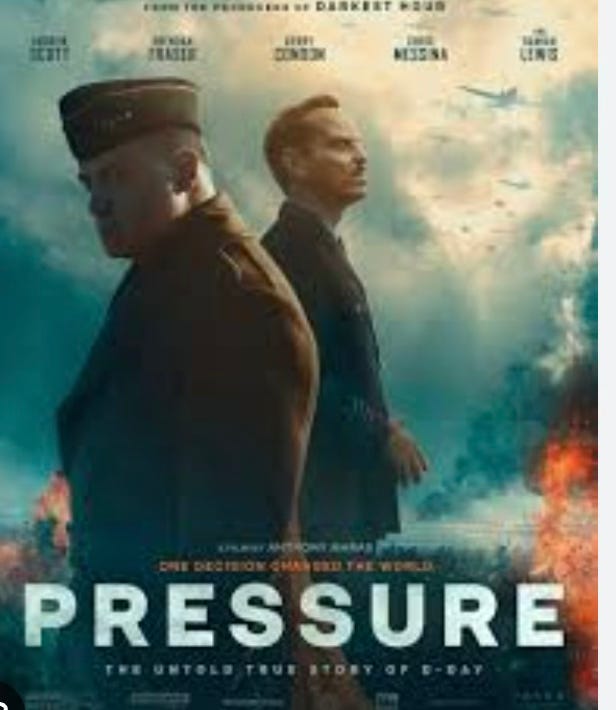
The film, Pressure, dropped right before the anniversary of D-day last week and was a tribute to when government, military and science all trusted each other and our allies.
After we saw it a week ago, it gave me pause. I thought “this is how it is supposed to work.” Now? It is the opposite. What happened?
The story is a tense historical thriller set during the 72 hours leading up to D-Day. It follows the true, little-known history of James Stagg, the Chief Meteorological Officer for the Allied forces, who had the immense pressure of predicting the weather to determine the fate of the Normandy invasion.
There’s a remarkable scene in the “Pressure” that deserves more attention than it received. The movie dramatizes one of the most consequential weather forecasts in human history — the decision made by Allied Supreme Commander Dwight D. Eisenhower on the eve of the D-Day invasion. Surrounded by generals, admirals, and anxious yes-men all eager to move forward, Eisenhower did something almost radical by today’s standards: he listened to a meteorologist.
Group Captain James Stagg, a Scottish meteorologist with no stars on his shoulders and no political agenda in his briefcase, told Eisenhower something nobody wanted to hear. The weather window originally planned for June 5, 1944 was going to be catastrophic. Storms would ground aircraft, swamp landing craft, and turn the beaches of Normandy into a killing field even before a single Nazi bullet flew.
The generals pushed back. The pressure, pun absolutely intended, was enormous. An entire invasion force was coiled like a spring, ready to launch. Logistics, morale, and secrecy all argued for going now. But Stagg held firm, presenting his data, his models, and his professional judgment with calm. And Eisenhower, the supreme commander of the greatest military operation in human history, trusted the science.
He delayed the invasion by one day. June 6, 1944 — D-Day — became the turning point of World War II. Had Eisenhower dismissed the meteorologist in favor of what he wanted to hear, history might read very differently today.
Dwight Eisenhower went on to be a Republican president and tended to have more progressive views than his party on many topics.
The Party That Once Built Institutions
Here’s what makes this story more than just a great war anecdote: Eisenhower carried that same respect for expertise directly into the White House. As president, he championed the Interstate Highway System, invested passionately in science education after space research hit some lows, rattled American confidence, and understood that governing a complex nation required trusting people who actually knew things.
That tradition didn’t die with Ike. It lived on, surprisingly enough, through some of the most consequential Republican administrations of the 20th century.
Consider Richard Nixon. Nixon, not exactly a figure celebrated for his moral clarity and yet in 1970, Nixon signed into law the legislation creating the Environmental Protection Agency. Let that sink in for a moment. A Republican president, responding to scientific consensus about air and water pollution, built one of the most important regulatory institutions in American history. Nixon didn’t create the EPA because it was politically convenient. Frankly, it wasn’t. He created it because the science was undeniable, the rivers were literally catching fire, and governing responsibly demanded a response proportional to the evidence.
Even the Younger Bush Got It Right
Fast forward thirty years to another Republican president that history has treated with considerable complexity and famously, is known for war-mongering. George W. Bush, responding to the very real threat of bioterrorism and emerging infectious diseases, launched Project BioShield in 2004 — a multi-billion dollar initiative to develop vaccines and medical countermeasures against biological, chemical, nuclear, and radiological threats.
You can debate the Iraq War and you should. You can debate tax policy and boy, should you. But BioShield represented something genuinely admirable: a president looking at scientific threat assessments, listening to public health experts, and making a long-term investment in American safety based on evidence rather than ideology. The program helped build the very infrastructure that would later prove essential in responding to pandemic threats.
So What Happened?
The Republican Party that Eisenhower built - the one that delayed D-Day on the word of a meteorologist, that created the EPA, that funded biodefense research, was a party that understood a fundamental truth: reality doesn’t negotiate.
Storms don’t care about your invasion timeline. Pollution doesn’t respect party affiliation. Viruses don’t read political platforms.
The Republican leaders of the 20th century understood that expertise wasn’t the enemy of leadership — it was the foundation of it. Eisenhower didn’t feel diminished by listening to James Stagg. He felt informed. And 160,000 Allied troops lived to fight because of it.
We don’t need to romanticize the past to learn from it. None of these politicians were perfect in any way. We just need to remember that rational governance isn’t a partisan idea. It’s a survival strategy.
Confidence in science among Republicans did not drop at a single moment but declined over several decades, with the sharpest drops accelerating in the 1980s and again in the late 2010s and 2020s. This shift is attributed to the merging of anti-regulatory economic interests and cultural polarization.
The transition to modern science skepticism was driven by a few conservative movements.
Distrust of Government and Regulation (1980s): During the Reagan administration, conservative business leaders and think tanks cultivated a narrative that government regulations stifled economic growth. Because much of the scientific research regarding environmental issues (like acid rain and the ozone layer) necessitated government intervention, the science itself came to be viewed by conservatives as a threat to free-market principles.
The Climate Change Debate (1990s–2000s): The divide hardened over climate science. As scientists documented the need to reduce fossil fuel use, conservative strategists and industry groups launched coordinated campaigns to cast doubt on this consensus. This transformed climate science from an empirical issue into an economic and partisan wedge issue.
Cultural and Religious Shifts: An increasing alignment between the GOP and fundamentalist Christian groups contributed to skepticism of fields like evolutionary biology and reproductive rights.
Institutional Distrust and the Pandemic (2020s): The divide expanded from environmental science to public health. During the COVID-19 pandemic, public health mandates such as masking and vaccines were viewed by many conservative leaders as government overreach. Discrediting scientific experts and institutions became a way to demonstrate political loyalty and protect individual liberty.
Sociological data, such as longitudinal studies published by Gallup, highlights that Republican confidence in science fell from 72% in 1975 to 45% in recent years, while Democratic confidence increased significantly over the same period.
Now, the question will be, will the Democratic Party fully step up and lead us into an age of science and actually deal with AI, data centers, climate change and pandemics in a full throated way?
I am quite hopeful.
Have a great day,
M.
P.S. If this was interesting or helpful, please give it a share or a like. Or, consider a paid subscription.
Thanks for a very solid analysis of what happened to the Republican Party .If I had to sum it up in one word, it would be greed.
I wish I could share your optimism that the Democrats can turn this around. I am not sure but I hope you are right.
Yeah, I'm hopeful too. But doubtful.